
VE Tuning – VF Tuning for both HSV & Commodores
E38 ECM
General Motors (GM) in Australia began using the E38 Engine Computer Module (ECM) in 2005. This was first seen in the Holden VZ 6L. The HSV 6L 297 model used a different module, the E40. GM then continued to use the E38 ECM in the VE V8 models and currently in the VF V8 models. There are a few different part numbers for the E38 ECM and they aren’t interchangeable from year to year. As a result, the operating system in the E38 ECM has changed multiple times. This means that the tune settings cannot be transferred between the different sub-models. When tuning an engine with an E38, it is important to modify the car’s original read file. Alternatively, you should start with the correct model’s file before making any adjustments.
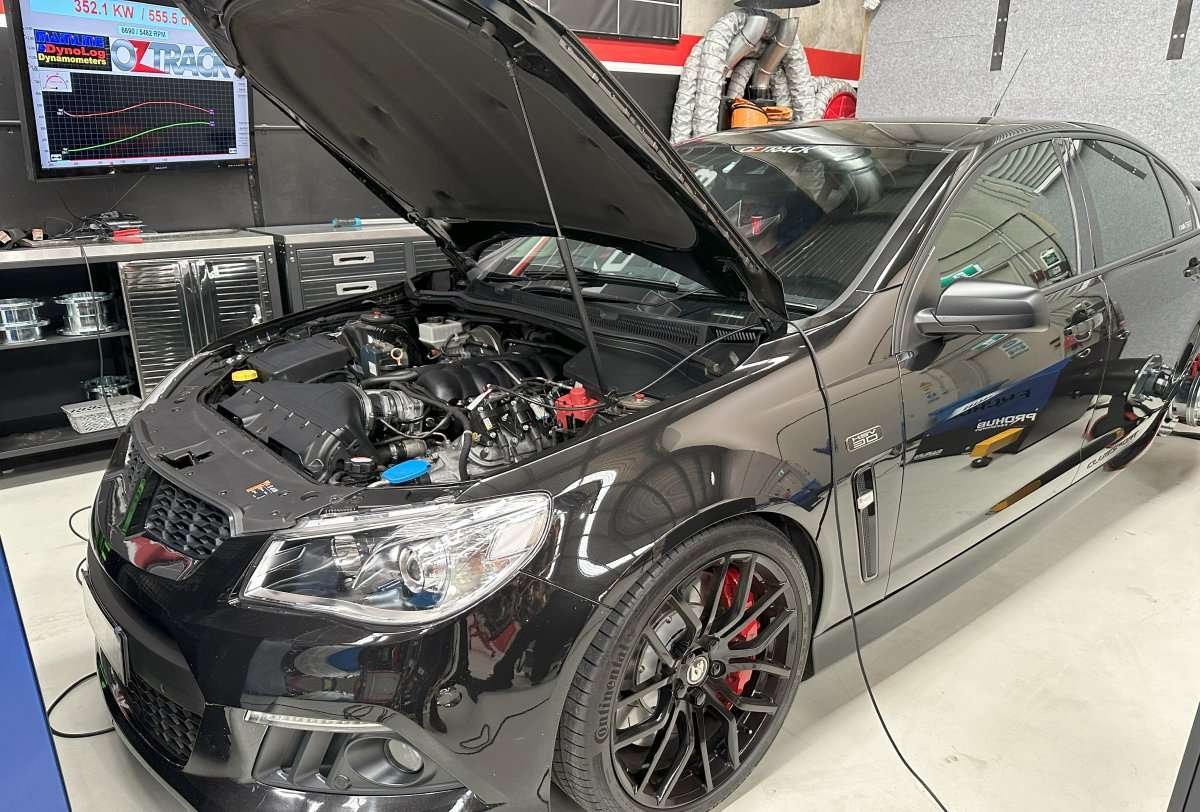
Oztrack started development in the tuning of E38 ECM-equipped engines in early 2007. Our first car was on the 10th of May 2007, close to the first day that EFILive released support for tuning the VE. Since then, we have tuned over 5000 vehicles with E38 ECMs. In addition to tuning for our customers, we provide a tuning service for workshops worldwide. We assist remotely with the tuning process.
The E38 ECM is more complex than the LS1 powertrain computer module (PCM). This difference is clear when comparing their read files. The LS1 computers in the VT-VY models have a memory size of about 512Kb. In contrast, the E38 computer has a larger memory of nearly 1706Kb. Additionally, the T43 Transmission module operates separately with a memory size of 1599Kb. The E38 factory operating systems use a complex equation to manage fueling. It is important to adjust this equation to control the fuel delivery effectively. This makes things more difficult than just adjusting a single table. The ECM processes data much faster than the LS1 PCM. This means it can correct issues and hide poor tuning more effectively than the LS1. This can result in other bad effects like flat spots and erratic rpm when coasting slow or decelerating.
The factory settings can be improved for better performance and economy.
Tuning the engine improves fuel economy. This is because we can make the air-fuel ratios more accurate. We can also optimize the timing table values and curves. Some of this is possible because Holden designed the engine to use 91 unleaded fuel. However, this fuel has a low octane rating for the engine’s compression ratio. It’s strongly recommended that at least 95 octane fuel is used. Using 98 octane fuel generates more low-end torque than 91 octane. This allows the engine to use less fuel when it is properly tuned for 98.
The responsiveness can be improved by optimizing how the electronic throttle opens. It is also important to adjust how quickly the fuel changes and the timing of the spark advance.
Full power can be improved by optimizing timing values, transitions, and the air-fuel ratio. These changes can be seen in the exhaust. In our tuning strategies, we have identified over 100 areas of the factory tune calibration that we change.
Do I need a tune?
If you change your air intake you need the engine to be tuned. This is because there are specific airflow limits that are monitored. If these limits are exceeded, the engine may go into limp mode. This mode can cause your car to slow down or stop unexpectedly while driving. When the engine is tuned, these airflow limits are adjusted to exceed the limp mode activation levels safely. It is unsafe to fit an air intake and hope for the best regardless of whether it’s a maf or mafless intake. The intake will cause the car to run leaner when under load. This is harmful to the engine and will reduce its performance. Some problems will occur immediately, or the engine will learn fuel mixtures out of range after a few weeks.
If you change your exhaust, the rear O2 sensors will monitor for signs of catalytic converter failure. They may also trigger engine lights because of error codes. These error codes are adjusted when the engine is tuned.
Changes to the exhaust and air intake will affect fueling and timing. This creates room for tuning to have a greater impact than on a standard car. Even just a catback install should be followed up with a tune.
MAF or MAFLESS
Standard cars use a mass airflow sensor (MAF). This sensor measures the amount of airflow into the engine. The engine control module (ECM) then matches this airflow with the correct amount of fuel. The mass-produced automobile market works well because more air than usual will be matched with more fuel. To tune a maf is a simple table with airflow on one axis and the fuel value on the other. This makes for simple tuning. The issue is that mass airflow sensors (MAFs) are not always accurate. They struggle to distinguish between high load at low RPM and low load at high RPM. Both situations can have similar airflow. This can lead to fueling being adjusted by the same value, which is a poor compromise. The MAF can detect turbulence and quickly change the spark timing advance. This happens because the MAF indirectly influences the timing advance values. Tuning an engine without the Mass Air Flow (MAF) sensor is quite challenging. In an E38-equipped engine, the fuel delivery is managed by a specific equation. This equation must be adjusted indirectly to ensure the fuel mixture is correct at all loads and RPMs. However, the advantage is that with mafless tuning, all different loads and rpms are uniquely controlled. It is essential with mafless tuning that the engine sensors are all healthy and working accurately. The intake air temperature sensor, coolant temperature sensor, and manifold pressure sensor affect the fueling. It is important for the intake air temperature sensor to report the correct convective air temperature. It should not mistakenly report radiant heat from the solid parts of the air intake. The factory intake air temperature (IAT) sensor is found inside the mass air flow (MAF) sensor. It is located next to a hose that connects to the coolant radiator. This hose often heats the IAT and makes it report temperatures well above the real induced air temperature. We have seen IAT temps of 80 degrees on a 25-degree day. The result of this error is unstable air-fuel ratios. These ratios are often leaner than what is ideal.
First sub12s 6L 6 spd auto Commodore in the World NA
On the 21st of May 2008, Paul’s car, tuned by us, did 11.867 and 118.7mph at the Sydney Dragway. Racing with full exhaust and in street trim, all four wheels swapped. The car and driver weighed in at 1780kg on the Sydney Dragway weighbridge.
The timeslip data was
1.856
5.093
7.707 @ 95.19 mph
9.967
11.867 @ 118.71 mph
Some acceleration figures from the log.
0-100kph 3.81s
0-160kph 8.12s
0-190kph 11.34s
The weather conditions were
12.0 deg
13kph wind from the SW
78% RH
1027MB
This car was a 6L L98 running a small cam, imported heads, and tune. This was with the stock stall converter 6 Spd auto. Its best result on the same dyno we use now was 326 rwkw.
Click this link for more information about what we tune.