Table of Contents
- Preparing Your LS for Tuning: Hardware and Foundations
- The 5-Step LS Tuning Process: From Base Map to WOT
- ProHub Dyno vs. Remote Tuning: Choosing Your Path
Preparing Your LS for Tuning: Hardware and Foundations
A great tune is only as good as the hardware it supports. Before we even think about connecting a laptop, it’s crucial to ensure your LS engine has the right foundations. A custom calibration can’t fix a mechanical problem or a poorly chosen part.
- Quality Intake: For any Gen IV engine like an LS3 or L77, a high-quality Over-The-Radiator (OTR) intake is non-negotiable. A VCM OTR provides the cool, dense air charge needed to make real power safely.
- Fuel System Health: Your fuel pump and injectors must be able to keep up with the new power demands. We check fuel pressure and flow to prevent dangerous lean conditions on the dyno.
- Mechanical Pre-Check: Head Tuner Steve and the team at our Penrith workshop insist on a thorough pre-check. We look for vacuum leaks, exhaust restrictions, and ensure your oil and fluids are fresh before any tuning begins; you can also check out BioKem Oil Services for specialised lubrication analysis and filtration.
The Role of Exhaust and Intake Synergy
Your engine is an air pump. Improving how it breathes in (intake) and breathes out (exhaust) is fundamental to unlocking performance. The two systems must work together, and the tune is what synchronises them. (LS-based small-block engine family)
A full system like a Manta DPE exhaust for a VE or VF Commodore dramatically changes the engine’s backpressure. This requires significant adjustments to the calibration to optimise flow and prevent torque loss. This is also why "Mafless" tuning is often the preferred path for Australian LS builds, as it allows us to remove the restriction of the factory Mass Air Flow sensor and tune purely on engine speed and pressure.
Read More: Manta Exhaust for VE Commodore: The Ultimate Performance & Sound Guide
Fuel Quality and Spark Advance
Not all fuel is created equal. In Australia, we are fortunate to have access to high-quality 98 RON premium unleaded fuel. Our tunes are specifically calibrated to take advantage of this, allowing for more optimal spark timing than is possible with lower-octane fuels found overseas.
However, we always prioritise engine safety. Pushing for the absolute maximum spark advance to find the last two kilowatts introduces unnecessary risk. A "safe" tune with smooth timing curves delivers reliable power and better drivability, which is the Oztrack philosophy.
The 5-Step LS Tuning Process: From Base Map to WOT
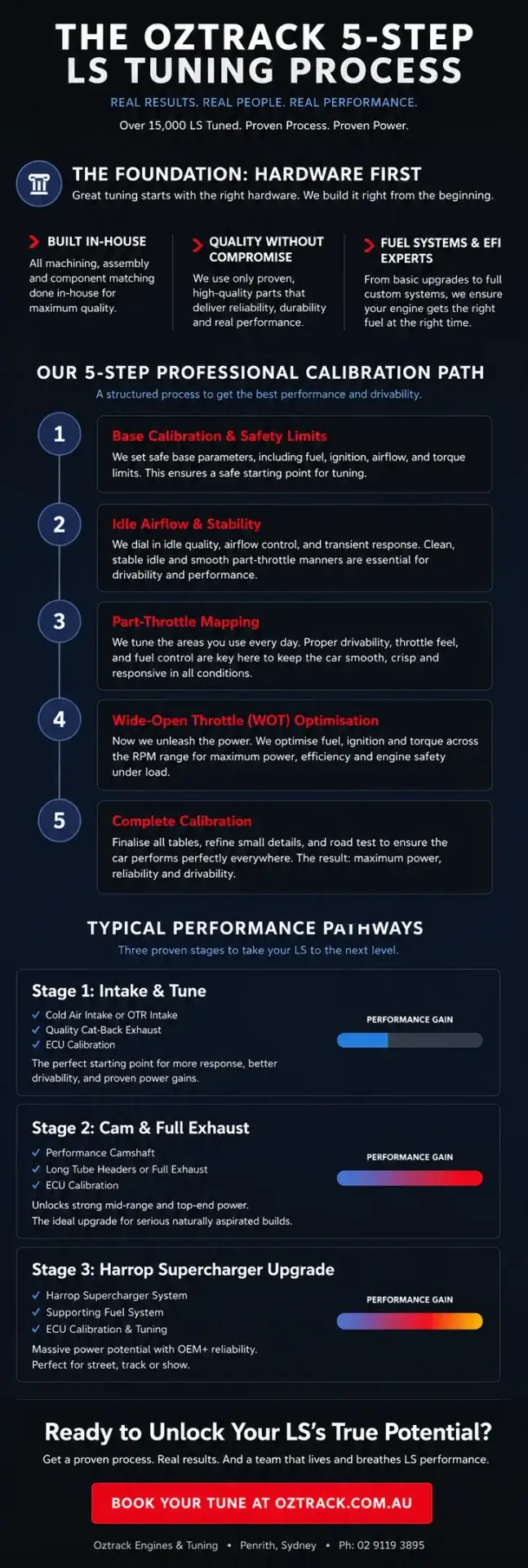
Tuning an LS engine is a methodical process. We follow a specialised 5-step procedure to ensure every aspect of the engine’s performance is optimised, from a cold start to a full-throttle power run.
- Establish the Base Calibration: We start by reading your factory file and establishing safety limits. This includes setting appropriate rev limiters, adjusting fan temperature settings for better cooling, and disabling functions that are no longer needed (like rear O2 sensors after an exhaust upgrade).
- Idle Air-Flow Tuning: This is critical for drivability, especially with a big camshaft. We meticulously adjust idle airflow and spark tables to achieve a stable idle, whether you want a smooth sleeper or that famous "lumpy cam" effect at the traffic lights.
- Part-Throttle Mapping: This is where you spend 90% of your driving time. We calibrate the fuel and timing maps for crisp throttle response, smooth power delivery, and optimal fuel economy during daily driving.
- Wide Open Throttle (WOT) Optimisation: With the car safely bolted on the hub dyno, we command WOT to dial in the air-fuel ratio and spark timing for maximum safe torque and horsepower. This is where we chase the power figures. We experiment to see what AFRs and Spark advance the engine performs the best. The Prohub is very precise and we can see the effects comparing back to back runs.
- Final Verification: The final step is to verify the tune’s performance in real-world conditions.
Mastering the LS Idle and Drivability
One of the biggest complaints with poorly tuned, cammed cars is stalling and surging. Our Tuner, Steve, specialises in mastering the "Adaptive Idle" system. He carefully adjusts specific tables to teach the ECU how to handle the airflow characteristics of an aggressive camshaft, preventing stalling when coming to a stop. (LS Tuning For Optimum Performance)
For manual VE and VF Commodores, we also have a few strategies to address the common "shunting" or "bucking" at low speeds. Often this is made worse by some clutches. By refining the part-throttle tables, we can deliver a smoothest possible driving experience, even in heavy Sydney traffic.
Explore Options: LS Cam Upgrade Dyno Tuning Packages
MAF vs. Mafless Tuning: Which is Right for You?
For most performance applications, especially those with a VCM OTR intake, we recommend a Speed Density tune (commonly known as a "Mafless" tune). This removes the restrictive factory MAF sensor, allowing the engine to breathe more freely and giving us more precise control over fuelling.
However, there are situations where retaining the Mass Air Flow sensor is beneficial. For a "stealth" street build or in specific regulatory environments, a MAF tune can provide excellent results while appearing completely stock under the bonnet.
ProHub Dyno vs. Remote Tuning: Choosing Your Path
Getting your LS engine tuned at Oztrack gives you two excellent options, whether you’re local to Penrith or live on the other side of the country. Each path is designed to deliver the same high-quality, customised calibration.
- In-House Dyno Tuning: Our workshop at Unit 8, 28 Coombes Dr, Penrith NSW, is home to a Mainline ProHub dyno. This advanced machine eliminates wheel spin and tyre variables, providing the most accurate and repeatable data possible. You can even watch on two big TVs in our lobby while the tune is being done.
- Professional Remote Tuning: With experience from tuning over 10,000 vehicles, we have developed a world-class remote tuning process. It’s a safe, proven, and effective option for enthusiasts in regional NSW, QLD, WA, or anywhere else in Australia. For those in the UK seeking similar expert support, you can visit Naked Frog Vehicle Tuning for professional mobile remapping.
The Power of the Mainline ProHub
Unlike a traditional roller dyno, a ProHub dyno bolts directly to the vehicle’s wheel hubs. This direct connection means we get 100% accurate data every single time, with no power loss or inconsistencies from tyre slip, growth, or differing tie-down pressures. For high-power builds, particularly supercharged LSA engines, the ProHub is the only way to measure and calibrate performance with absolute precision.
Learn More: The Ultimate Guide to Mainline ProHub Dyno Tuning
Remote Tuning with AutoCal V3
Don’t live near Sydney? No problem. Our remote tuning process is simple and effective. We send you an AutoCal V3 device, you perform some data logs of your car, and email the files to us. Steve then builds a custom tune specifically for your car and its modifications.
These are not generic, "off-the-shelf" files. Every remote tune is custom-tailored based on your logs, just as if the car were here on our dyno in Penrith. It’s a personalised service that brings our workshop expertise directly to you.
Get Started: Remote Custom Tuning using AutoCal V3
Frequently Asked Questions
How much extra power can I expect from a basic tune and OTR intake?
For a typical 6.0L (L77/L98) or 6.2L (LS3) Commodore, an OTR intake and a custom tune on 98 RON fuel usually yields an increase of 25-35 rear wheel kilowatts, along with a significant improvement in throttle response. Exhaust Upgrades like a DPE Exhaust or Manta exhaust can add another 25 rwkw.
Do I need to upgrade my fuel pump for a naturally aspirated LS tune?
For basic bolt-on modifications (intake, exhaust, tune) on a naturally aspirated LS engine, the factory fuel pump is generally sufficient. A fuel pump upgrade only becomes necessary with major modifications like aggressive camshafts or forced induction.
What is the difference between a ‘Street Tune’ and a ‘Dyno Tune’?
A Dyno Tune is performed in a controlled environment on a dynamometer, allowing for safe WOT calibration and precise measurement. A ‘Street Tune’ involves tuning the vehicle on public roads, which is less precise for calibrating WOT conditions.
Can you tune my VE/VF Commodore remotely if I live in regional QLD or WA?
Absolutely. Our remote tuning service is designed for customers all over Australia. We send you all the required hardware and provide clear instructions for data logging, allowing us to build a custom tune for you no matter where you are. For our Brisbane-based enthusiasts who appreciate the same level of technical care for their homes as they do for their cars, Pool Blitz offers specialist pool servicing and water balancing.
Why does my car smell like fuel after a cam tune?
A strong fuel smell is often caused by valve overlap, a characteristic of high-performance camshafts where both the intake and exhaust valves are briefly open. This can allow unburnt fuel to enter the exhaust at low RPM. A skilled tuner can minimise this, but it can be a normal trait of a cammed V8.
Can you tune other makes and models of car on the Dyno at Oztrack?
Yes, we regularly tune many different makes and models at Oztrack using HP Tuners, EFILive, Haltech and other tuning platforms.
Some of the vehicles we commonly tune include:
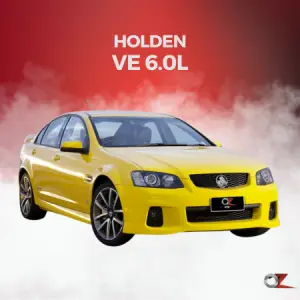
- Holden Commodore LS1, LS2, LS3, L98, L77, LSA and LT platforms
- HSV models including GTS, Clubsport, Maloo and Senator
- Ford Falcon XR6 Turbo and XR8
- Ford Mustang GT and supercharged Mustang combinations
- Chevrolet Camaro and Silverado
- Dodge RAM and Chrysler SRT vehicles
- Jeep SRT and Trackhawk
- Toyota LandCruiser and Tundra V8
- Nissan Patrol Y62
- LS engine conversions in older vehicles and race cars
- Many diesel vehicles. Colorado, Hilux, Navarra, DMAX, 79 series,Triton etc.
- ask us about other cars
We can tune:
- Naturally aspirated combinations
- Camshaft packages
- Supercharged combinations
- Turbocharged setups
- Flex fuel and E85
- Engine conversions
- Race and circuit vehicles
Our workshop uses a Mainline Prohub dyno which allows accurate hub-based dyno testing with excellent consistency and load control.
We also tune many standalone ECU systems including:
- Haltech
- Holley
- Link ECU
- MaxxECU
- MoTeC
If you are unsure whether we can tune your vehicle, contact us with:
- vehicle make and model
- engine combination
- ECU type
- modifications
and we can let you know what is possible.
Oztrack has tuned over 15,000 vehicles and uses a Mainline ProHub dyno for accurate testing and calibration. The workshop focuses heavily on Holden Commodores, HSV models and other GM LS platforms, while also tuning Ford, Chrysler and Jeep performance vehicles.
Services include dyno tuning, Harrop supercharger installations, LS engine machining and rebuilding, transmission tuning, fuel system upgrades and remote tuning using AutoCal V3 devices.
Oztrack also supplies base tunes and technical support to workshops across Australia and internationally.

Article by
Oztrack
Oztrack Engines and Tuning is a performance workshop based in Penrith, Sydney, NSW, specialising in LS and LSA engine tuning, dyno tuning, camshaft upgrades, supercharger packages, engine builds and remote custom tuning across Australia.
Oztrack has tuned over 15,000 vehicles and uses a Mainline ProHub dyno for accurate testing and calibration. The workshop focuses heavily on Holden Commodores, HSV models and other GM LS platforms, while also tuning Ford, Chrysler and Jeep performance vehicles.
Services include dyno tuning, Harrop supercharger installations, LS engine machining and rebuilding, transmission tuning, fuel system upgrades and remote tuning using AutoCal V3 devices.
Oztrack also supplies base tunes and technical support to workshops across Australia and internationally.