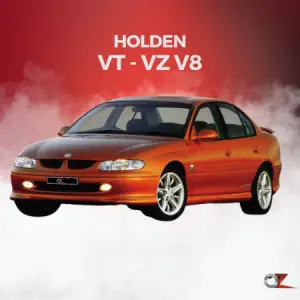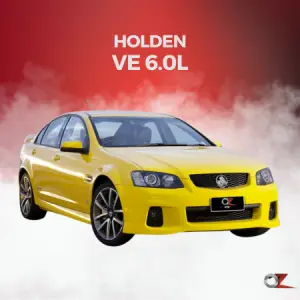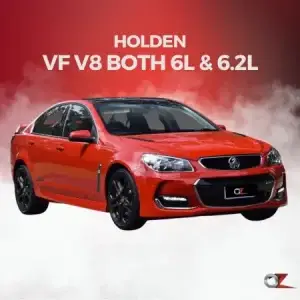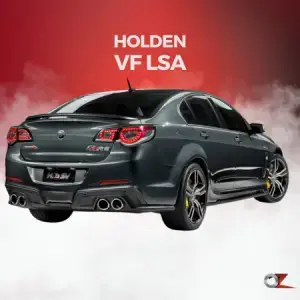
LS Camshaft Specifications and Comparison
Compare Oztrack FE, DR, HP and GT camshafts for LS1, LS2, L98, L76, L77, LS3 and LSA engines. Choose around the way the car will be used, not just the largest duration number.
Oztrack camshafts are designed and manufactured in Australia. We select, install and calibrate LS cam packages using real workshop experience and Mainline ProHub dyno testing in Penrith, NSW. Remote cam packages and tuning support are also available Australia-wide.
The best LS cam is the one that suits the complete combination
Duration, lift and lobe separation matter, but they do not tell the whole story. Engine capacity, compression, cylinder heads, exhaust, gearing, transmission, converter, vehicle weight and intended RPM range all change the result.
Street manners
Idle quality, brake vacuum, low-speed torque and fuel use matter in a daily-driven Commodore or HSV. A bigger cam can give up behaviour you value more than the final power gain.
Automatic or manual
An automatic needs the cam, converter, idle calibration and transmission tune to work together. Manual cars can accept more overlap and a higher operating range.
Naturally aspirated or boosted
A naturally aspirated LS3 and a supercharged LSA do not need the same exhaust timing. Boost, backpressure, fuel system capacity and power target affect the correct profile.
Oztrack LS camshaft comparison
The ratings make the trade-offs clear. A higher idle-quality score means a smoother idle. Higher driveability and economy scores are better. Power rises as the cam becomes more aggressive.
| Cam | Intake duration | Exhaust duration | Valve lift intake/exhaust | LSA | Idle quality 1–10 | Driveability 1–13 | Fuel economy 1–13 | Power 1–13 | Best RPM range |
|---|---|---|---|---|---|---|---|---|---|
| FE | 212° | 218° | .562/.560 | 113° | 10 | 10 | 10 | 5 | 1400–6500 |
| DR | 218° | 228° | .575/.580 | 114° | 8 | 9 | 9 | 6 | 1700–6500 |
| HP1 | 223° | 230° | .608/.608 | 114° | 7 | 7 | 7 | 7 | 2200–6600 |
| HP3 | 227° | 236° | .608/.608 | 115° | 6 | 6 | 6 | 8 | 2700–6800 |
| HP9 | 229° | 244° | .629/.608 | 114° | 5 | 5 | 6 | 9 | 2900–6900 |
| HPS | 232° | 236° | .648/.615 | 112° | 3 | 3 | 3 | 10 | 3200–7000 |
| HPX-R* | 235° | 248° | .649/.615 | 111° | 2 | 3 | 2 | 12 | 3600–7000 |
| GT* | 236° | 244° | .593/.615 | 112° | 3 | 3 | 3 | 10 | 3200–7000 |
| GTX-R* | 240° | 244° | .648/.615 | 111° | 1 | 3 | 2 | 12 | 3600–7000 |
* HPX-R, GT and GTX-R are aggressive high-RPM or competition profiles. They may require a stall converter, gearing and other supporting changes. The cam card supplied with the camshaft is the final specification.
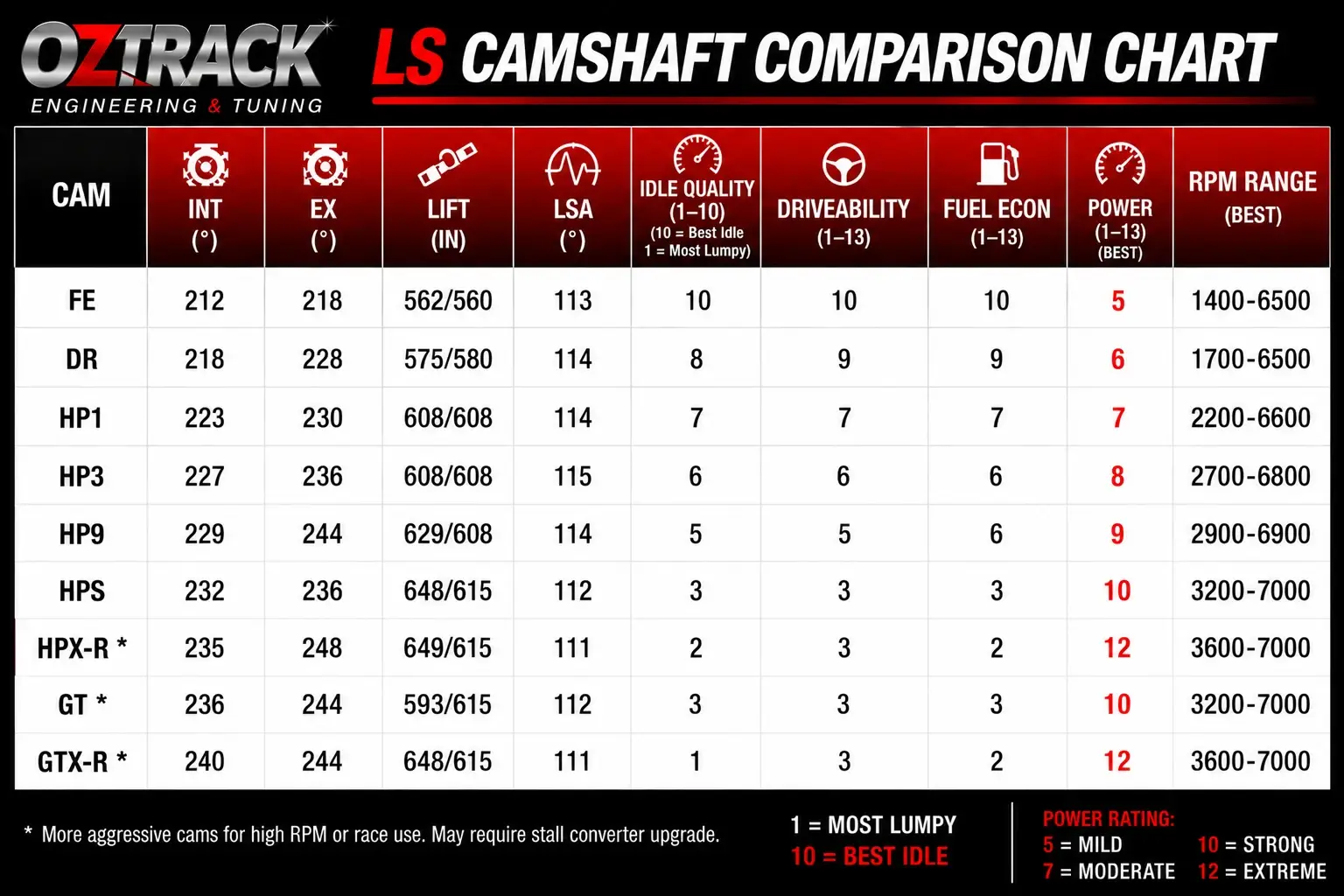
Select the chart to open the full-size version.
Which Oztrack cam should you choose?
These are starting points. Oztrack confirms the grind after checking the engine, transmission, current modifications and the way you want the car to behave.
Calm daily street car
Best idle quality, low-speed response and economy in the range. Suits owners who want added performance without making the car tiring in traffic.
Noticeable idle with strong manners
A step above FE in sound and power while retaining good driveability. A useful choice for daily use and touring.
Choppy street cam
A popular balance of idle character, street use and power. It can work with a standard converter in supported combinations when the calibration is correct.
Strong automatic street combination
The largest cam Oztrack commonly recommends for a street automatic retaining the standard converter. Calibration, brakes and complete vehicle setup become more important.
Aggressive street or performance use
Moves the useful range higher and gives up more low-speed behaviour. Converter, gearing, exhaust and intended use must be checked before selection.
Manual, high-RPM or competition use
HPS, HPX-R, GT and GTX-R suit combinations built around high airflow and RPM. Piston-to-valve clearance and the complete valvetrain must be verified.
Automatic Commodore guidance: FE, DR and HP1 can usually target about 650 rpm in Drive when the combination and tune allow it. HP3 is commonly set around 675 rpm. These are typical targets, not fixed settings for every engine.
Large cams reduce idle vacuum and can change brake-pedal assistance. Oztrack generally avoids recommending a high-stall converter for a normal street car unless the complete combination genuinely needs it.
LS1, L98, L77, LS3 and LSA camshaft guidance
The engine badge narrows the choice, but the vehicle and supporting hardware decide whether a cam will work well.
LS1 camshafts
The smaller LS1 needs a cam that preserves useful torque unless the car has gearing, compression and RPM to support a larger profile. FE, DR and HP1 suit many street combinations. GT and larger profiles are aimed at serious manual or competition builds.
LS2 and L98 camshafts
The extra capacity supports more duration than an LS1 while retaining street torque. HP1 and HP3 are common street choices. HPS and larger profiles need a combination built around the higher RPM range.
L76 and L77 camshafts
L76 and L77 engines use Active Fuel Management hardware. A conventional performance cam installation normally includes the correct AFM-delete parts, lifters, trays and calibration changes.
LS3 camshafts
LS3 capacity and rectangular-port heads respond strongly to a cam upgrade. FE through HP3 cover most street requirements. Manual cars and purpose-built combinations can use HPS, GT or more aggressive profiles.
LSA camshafts
Supercharged combinations need exhaust timing matched to boost, backpressure and power target. Fuel supply, valve springs, supercharger speed, charge temperature and safe engine speed must be considered with the cam.
Stroker and high-compression LS engines
Extra capacity and compression can make a larger cam behave better at low speed, but piston-to-valve clearance and valvetrain control become critical. Final selection should use the measured engine combination.
How factory LS camshafts compare
- LS1: mild timing designed for smooth idle, emissions and low-speed operation.
- LS2 and L98: slightly more airflow than LS1 while retaining factory manners.
- L76 and L77: designed around factory AFM operation and conservative valve events.
- LS3: greater intake lift to work with the larger engine and rectangular-port heads.
- LSA: factory supercharged profile with conservative overlap and wide operating behaviour.
A camshaft is only one part of a reliable LS cam upgrade
Parts and checks vary with the engine, cam profile, mileage and existing modifications. Oztrack assesses the complete combination before confirming the package.
Valvetrain
- Valve springs matched to lift and RPM
- Correct pushrod length and wall thickness
- Lifters and trays where required
- Retainers, seals and clearances checked
Engine hardware
- AFM-delete hardware for applicable engines
- Timing set and oil-pump condition assessed
- Piston-to-valve clearance for larger cams
- Intake and exhaust combination considered
Calibration
- Idle airflow and speed
- Fuel and ignition calibration
- Automatic transmission behaviour
- ProHub verification under load
Do not choose from duration alone. Two cams with similar 0.050-inch duration can behave differently because of lobe shape, lift, opening and closing points, installed centreline and the engine around them.
Real dyno testing matters more than a catalogue claim
Power varies with engine condition, compression, heads, intake, exhaust, fuel, transmission and weather. Oztrack uses Mainline ProHub testing to measure the finished combination and correct the calibration under controlled load.
The examples opposite are results already recorded by Oztrack from suitable combinations. They are evidence of what complete packages have achieved, not guarantees for every vehicle.
Search Oztrack’s dyno-results database or read how much power an LS3 can make with a cam.
LS camshaft FAQs
What is the best cam for an LS3 automatic?
For a street automatic, Oztrack normally starts with FE, DR, HP1 or HP3. HP3 is the largest cam we commonly recommend while retaining the standard converter. Vehicle weight, diff ratio, exhaust, brake vacuum and the owner’s tolerance for idle behaviour still need to be checked. Read the full LS3 automatic cam guide.
Can an LS cam work with the standard stall converter?
Yes, in the correct combination. FE, DR and HP1 are the easiest choices. HP3 can also work with a standard converter when the engine and transmission are calibrated correctly. More aggressive profiles may need a converter or may be unsuitable for a normal street car.
Will a larger cam make less torque at low RPM?
It can. As duration and overlap increase, the useful power range moves higher. Engine capacity, compression and gearing can reduce the effect, but a cam chosen only for peak power may feel weaker in ordinary driving.
Does an L76 or L77 need an AFM delete with a cam upgrade?
A conventional performance cam installation normally replaces the factory AFM lifters and related hardware with the correct non-AFM components. The ECU calibration must also be changed. Oztrack confirms the exact parts after identifying the engine and existing hardware.
Does every LS camshaft need new valve springs?
A performance cam requires springs that safely control the valve at the cam’s lift and intended RPM. Spring pressure, installed height, coil-bind clearance and retainer-to-seal clearance must suit the exact profile.
Why can a big cam affect the brakes?
More overlap can reduce intake-manifold vacuum at idle. A vacuum-assisted brake booster may then receive less assistance, especially during repeated low-speed braking. Cam choice, idle calibration and the braking system all matter.
Does the ECU need tuning after an LS cam upgrade?
Yes. The calibration must account for changed airflow, idle behaviour, fuel requirements, ignition timing and torque delivery. Automatic cars also need transmission settings matched to the new engine behaviour.
Can Oztrack supply a cam package outside Sydney?
Yes. Oztrack offers posted cam-upgrade packages and remote tuning for supported combinations. You must have access to compatible EFILive or HP Tuners hardware and suitable mechanical installation support.
Tell Oztrack how you want the car to drive
Send the vehicle model, engine, transmission, converter, diff ratio, current modifications, fuel, intended use and preferred idle quality. We can then recommend the right cam and supporting package.
Oztrack Engineering & Tuning · 8/28 Coombes Drive, Penrith NSW 2750